The Road Ahead: How Autonomous Driving is Reshaping the Global Transportation Industry
Autonomous driving has evolved from a research challenge into one of the most important engineering problems of the 21st century. Combining artificial intelligence, embedded systems, computer vision, robotics, and large-scale cloud computing, autonomous vehicles represent a unique intersection of computer engineering disciplines.
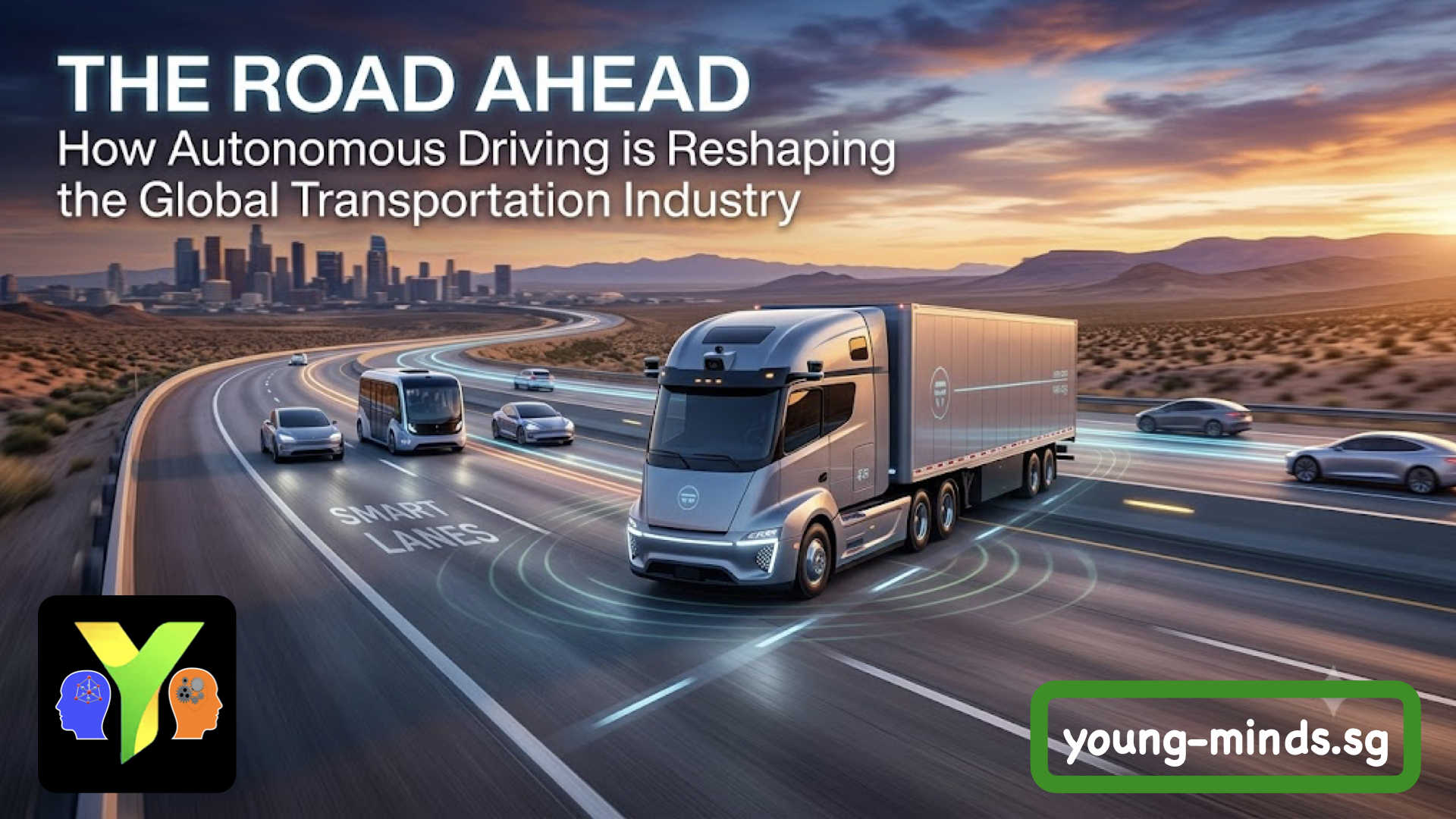
This article explores how the technology works, which companies are leading development, and how autonomous systems may reshape automobile industry, transportation and society.
For many decades, self-driving cars were dismissed as something out of science fiction. This dismissal no longer holds. In 2026, self-driven vehicles are a routine part of daily life in cities like Phoenix, San Francisco, Los Angeles, Austin and Beijing with markets expanding across cities throughout Europe and the Middle East. This is no longer a program in the research stage, with the technology slowly becoming mainstream, making it increasingly important to understand why this technology matters, which companies dominate the field, and what its future may mean for the roads we all share.
Perhaps the most important aspect of this shift is its impact on the global automobile industry. Autonomous vehicles are transforming how we think of car ownership, we are more likely to use on-demand, corporate-run fleets available 24/7, than to purchase and park our own vehicles. Future vehicle sales are more likely to be influenced by technology these companies possess, rather than traditional brand loyalty, which existed in the past. The automotive and transport Industries are among the largest employers of labour worldwide. However, the rapid evolution of technology may fundamentally reshape this labour market. New businesses and industries are emerging around autonomous mobility as commuting time becomes available for work, entertainment, shopping, and other activities. At the same time, a substantial amount of the global workforce currently employed in ride-hailing services face the prospect of significant disruption as this technology evolves and expands over the following years.
Why this Technology Matters
In the past, human error has caused the majority of accidents and collisions on the road. Distraction, fatigue, and impaired judgement aren’t one-off cases, but are the leading causes of accidents and vehicle crashes on our roads. Autonomous vehicles aren’t just a new invention, or gadget; they represent a real shot at fixing one of the most avoidable causes of injuries and harm in modern life.
These stats are backed by research carried out by JAMA Surgery and Waymo’s Safety Data Page. A modelling study published by JAMA Surgery estimated that autonomous vehicles could prevent more than a million road injuries in the United States alone between 2025 to 2035 – a roughly 3.6% reduction in traffic related injuries with impact rising alongside increased rates of adoption. This estimate matches with real-world data collected by Waymo that shows an 80% relative reduction in injuries compared to human driving, capturing the importance of this industry.
In addition to safety, this technology has other benefits too:
Disabled people, older adults, and those unable to obtain a driving licence may benefit from significantly increased mobility.
Commuters no longer have to drive and get more hours time which can be used for leisure or productively rather than driving.
Travel will be smoother and more efficient as consistent acceleration and deceleration as well as vehicle-to-vehicle communication makes the travel experience smoother.
Driverless trucking and transport will also reshape how goods are transported around the world.
Understanding the levels of Self Driving
Not all “self-driving” cars are created equal. The Society of Automotive Engineers (SAE) defines six levels of automation which is the single best tool for cutting through the noise and effectively finding out how advanced a system is.
DIAGRAM
These levels matter more than we realize because different brands have different names for their autonomous capabilities. For example, Tesla’s Full Self-Driving is in fact a Level 2 system, whereas Waymo and Baidu robotaxis operate at Level 4. True Level 5 unfortunately, does not exist commercially yet.
How Self-Driving Cars Work
For people interested in computer or automobile engineering, this is a fascinating topic. A self-driving car at its core, is a real-time distributed computing system housed in a car. There are four general functional layers: perception, localization, planning, and control:
Sensing and perception: The vehicle uses several sensor types to build an accurate picture of its surroundings.
Cameras: visual detail – lane markings, traffic lights, road signs, similar to human vision but can struggle in poor lighting or bad weather
Lidar (light detection and ranging): This system fires out laser pulses and measures the time taken to return to build a precise 3D map of the environment which is excellent for distance and shape calculations.
Radar: This system measures the speed and distance of objects using radio waves and also boasts reliable performance in rain, fog or darkness where cameras and lidar may struggle.
Ultrasonic sensors: These sensors can handle short-range detection which proves useful for parking and low-speed operations.
Sensor Fusion: No single sensor is fully trustworthy. Hence, sensor fusion is often performed which cross references data from every sensor at the same time so that if one source is degraded or wrong, the others can still provide accurate information. This processed data is used by perception models, usually convolutional neural networks and transformer-based architectures to classify and track the movement of pedestrians, vehicles, cyclists and obstacles. The model also estimates their velocity and predicts where they will be a few seconds into the future.
Localization: Along with knowing its surroundings, the vehicle also needs to know where it stands within a few centimetres of precision. This can be achieved by combining GPS data with high-definition maps and techniques like simultaneous localization and mapping (SLAM), which lets the car cross-check what it’s currently seeing against a pre-built map with details of the road, curbs and lanes.
Planning: With information about its surroundings and position, the planning layer decides what to actually do – which lane to be in, when to switch lanes, how to turn, when to stop, etc. This involves both long-range route planning and short-range trajectory planning with the exact path and speed profile for the near future. The system must also respect all traffic laws, keep safety margins and ensure passenger comfort.
Control: This layer translates the planned trajectory into real world output which includes: precise steering, acceleration, braking commands, and adjusting to road slope, traction and traffic. Corrections and commands can be executed faster than human reflexes allow.
Historically, autonomous cars divided driving into a neat, multi-step process of seeing the road, mapping its position, planning the route, and then controlling the car. Keeping these steps separate from each other made cars easier to test and certify for public roads as any mistake could be easily traced back to the source and code can easily be refined.
Today, the frontier is moving toward end-to-end learning. This approach no longer has hard-coded steps but has AI learn by watching millions of hours of human driving video, mapping raw sensor data into steering and braking. Emerging world technologies like AI “world models” give the car an internal sense of physics so that it can better generalize to previously unseen traffic scenarios.
The compute stack: None of this happens on ordinary hardware. Autonomous vehicles run onboard AI accelerators which are purpose-built to execute neural network inference multiple times each second along a safety-certified real-time operating system. This layer is what companies like Nvidia (DRIVE AGX and DriveOS) and Mobileye specialize in. This hardware has to operate and make split-second decisions under brutal real-world conditions such as the intense heat and power constraints of a moving vehicle. However, the real magic happens in massive, cloud-based data centres. Fleets of vehicles constantly stream real-world driving data back to the data centres. This data is used to retrain and sharpen the AI models. Before that new intelligence is ever released back out to the fleet, it is stress-tested across millions of virtual, simulated situations to ensure the model is safe for deployment.
It makes sense why top engineering graduates crowd into this space. Building an autonomous vehicle isn't a single discipline-it forces you to cross every boundary of computer engineering at once. You are actively forcing low-level embedded hardware and real-time computing to talk directly to computer vision, machine learning, and cloud networks. It is the ultimate sandbox for hardware-software co-design and safety-critical systems engineering.
Who's Actually Leading This Race
Waymo (Alphabet): The Infrastructure Play
Waymo has established itself as the definitive leader in fully driverless operations by pursuing a strategy of systematic validation. Rather than relying on algorithmic prediction to handle unknown environments, Waymo anchors its fleet to meticulously mapped operational domains. Their vehicles utilize an extensive hardware suite-integrating LiDAR, radar, and cameras-to build high-resolution, redundant safety models of the road.
This capital-intensive approach is delivering measurable market scale. Operating across major U.S. metropolitan areas including San Francisco, Phoenix, Los Angeles, and Austin, Waymo is currently managing a fleet of thousands of vehicles and logging hundreds of thousands of commercial rides weekly. Strategic integration with Uber’s network is accelerating their expansion into new tier-one markets like Atlanta, Miami, and Dallas.
However, scaling driverless technology in unstructured environments remains an active engineering hurdle. Federal regulators recently initiated investigations into the fleet regarding edge-case navigation errors, such as misinterpreting stopped school buses. These friction points serve as a reminder that transitioning from closed pilot programs to public infrastructure requires continuous algorithmic refinement.
Chinese Developers: Scaled Deployment and Expansion
China is no longer just a fast follower in autonomy; it is a primary center of gravity. Companies like Baidu (Apollo Go), Pony.ai, and WeRide are running massive deployments that match or exceed U.S. operations, converting autonomous transit into everyday public infrastructure across multiple mega-cities. WeRide, in particular, has branched out far beyond cars, adapting its modular driving stack for passenger buses, delivery vans, and street sweepers.
The real story now is international expansion. Both Pony.ai and WeRide are actively deploying fleets across the Middle East, Southeast Asia, and Europe. This geographic push proves that the autonomous race isn't a simple two-country contest between Silicon Valley and Beijing-it’s a highly competitive, multipolar global market.
Tesla: The Monocular Vision Gamble
If Waymo’s framework represents engineering caution, Tesla’s strategy is the industry’s most aggressive software-centric pivot. Tesla has completely decoupled its autonomous roadmap from expensive LiDAR or radar hardware. Instead, the company operates on a "pure vision" philosophy, betting that deep neural networks trained exclusively on high-resolution camera feeds can replicate-and eventually exceed-human visual perception.
Tesla's consumer-facing Full Self-Driving (FSD) software remains classified as an SAE Level 2 system, meaning the human driver remains legally responsible. Meanwhile, Tesla is attempting to develop Level 4 autonomous robotaxi services through its Robotaxi and Cybercab initiatives. The company’s broader commercial objective centers on a structural transition: deploying their custom Cybercab and deploying over-the-air software updates to transition existing Model 3 and Model Y consumer vehicles into a distributed, autonomous ride-hailing network.
This approach divides the computer engineering community. The central technical debate hinges on whether a system relying purely on passive optical data and machine learning can safely match the depth-perception accuracy of active laser sensor fusion. Resolving this question is currently the highest-stakes AI deployment challenge in the automotive sector.
Zoox (Amazon): The Purpose-Built Architecture
Zoox completely rejected the industry norm of retrofitting standard cars. Instead, the Amazon subsidiary designed a completely unique, bidirectional vehicle from scratch. By dropping legacy components like steering wheels and pedals, they unlocked a symmetrical, carriage-style cabin built entirely around passenger comfort rather than driver mechanics.
They are now scaling up. Through a major partnership with Uber, Zoox launched driverless operations in Las Vegas, with Los Angeles slated next. The company's immediate engineering hurdle isn't the software-it's clearing the final federal safety exemptions required to move their custom vehicle from supervised test tracks into full, uncrewed commercial service.
Mobileye: The Foundational Layer
Mobileye operates quietly in the background. Instead of spending billions managing its own fleet of robotaxis, the company acts as a foundational tech supplier to the rest of the industry. They specialize in the core computer vision processors and machine learning driving policies that power other brands, supplying critical automation hardware to Volkswagen, Ford, Zeekr, and NIO.
This B2B model shifts their revenue strategy entirely. Mobileye doesn't need to fight for individual ride-hailing fares. Instead, they monetize the autonomous shift by embedding their proprietary tech directly into millions of mass-market consumer and commercial vehicles around the world.
Mercedes-Benz: Strategic Recalibration
Mercedes-Benz stands out for its sheer technical ambition, but its latest moves offer a massive reality check for the entire industry. The brand initially locked in bragging rights as the first global automaker to commercialize a certified SAE Level 3 system. Their Drive Pilot software legally let drivers take their eyes off the wheel under strict, low-speed highway conditions in Germany, California, and Nevada.
Then came a massive pivot. Mercedes surprised the industry by removing Drive Pilot from its redesigned U.S. S-Class, swapping it for an advanced Level 2++ setup called MB.Drive Assist Pro.
This isn't a surrender; it's a tactical reboot. The reality is that Level 3’s hyper-specific operating parameters severely restricted its real-world utility for the average consumer. Instead of forcing a narrow product, Mercedes pivoted its engineering focus onto two separate horizons: a faster Level 3 system capable of handling highway speeds up to 81 mph, and a completely driverless Level 4 architecture. They are already testing an S-Class robotaxi prototype on the roads of Abu Dhabi and exploring a commercial vehicle integration with Uber. To get there faster, they’ve tied their entire computing roadmap directly to Nvidia's hardware and software stack.
Nvidia: The Industry's Engine Room
Nvidia doesn't build cars. Yet, it operates as the one of the most influential technology providers in the autonomous vehicle ecosystem. Their DRIVE Hyperion platform acts as a unified engineering foundation, bundling onboard supercomputing hardware with a safety-certified real-time operating system. Crucially, they are moving heavily into algorithmic reasoning with their open-weights Alpamayo AI models, which are built to improve reasoning capabilities in complex and unpredictable scenarios.
What truly secures Nvidia's market position is its aggressive commitment to an open ecosystem. While Tesla fiercely guards its closed-loop software, Nvidia takes the exact opposite approach. They open-sourced their Alpamayo models-including a massive 32-billion-parameter reasoning model optimized for Level 4 robotaxis-and published the code directly on Hugging Face. They even threw in open simulation frameworks and thousands of hours of real-world driving data for anyone to use.
This open-door policy is a brilliant commercial moat. By giving away the core machine learning building blocks and simulation suites, Nvidia lowers the barrier to entry for legacy brands and agile startups that lack the resources to code a proprietary stack from zero. It channels the entire global industry directly onto their silicon and CUDA developer platforms.
The strategy is a clear success. The Mercedes-Benz CLA launched as the first mass-production vehicle utilizing this complete Alpamayo stack. Meanwhile, Nvidia's hardware and cloud pipeline now power an incredibly broad roster of automotive giants-including Toyota, General Motors, BYD, and a massive joint Level 4 initiative with Hyundai and Kia-alongside a cross-continental fleet deployment deal with Uber.
Other Legacy Automakers: The Partnership Model
The rest of the traditional automotive sector is reaching a clear consensus: trying to build a proprietary autonomous driving stack completely in-house is an incredibly fast way to burn through billions of dollars. The engineering challenges are simply too steep to tackle alone. As a result, the established players are staying relevant by forming deep technical alliances.
Volkswagen’s software arm, CARIAD, is concentrating its resources heavily on Level 4 commercial applications. Simultaneously, Toyota’s specialized division, Woven by Toyota, is upgrading its driver-assist platforms by collaborating directly with the team at Waymo. Other premium manufacturers are skipping the internal development headache entirely. Luxury brands like Jaguar Land Rover are simply building their newest vehicle architectures straight on top of Nvidia's DRIVE platform from the ground up, letting the tech sector handle the heavy digital lifting while they focus on manufacturing the cars.
A Global Map That’s Easy to Miss
It is tempting to treat autonomous driving as a localized Silicon Valley story. It isn't. The global landscape is highly fragmented, with different regions taking wildly different approaches to deployment, regulation, and hardware integration.
The United States: The U.S. continues to push the highest volume of commercial robotaxis onto public roads, driven primarily by Waymo's scaling and Tesla's software ambitions. However, deployment is a complicated balancing act. Developers have to constantly navigate a highly fractured patchwork of state-by-state regulations alongside tightening oversight from federal safety investigators.
China: Operating at a scale that directly rivals the U.S., China benefits from a heavily coordinated, centralized regulatory approach. Companies like Baidu (Apollo Go), Pony.ai, and WeRide treat entire cities as open testing grounds. Concurrently, major domestic automakers like BYD and Geely are building Level 4-ready computing architecture straight into their consumer production lines via Nvidia's hardware.
Germany and the European Union: Europe chose to prioritize regulatory frameworks over rapid scaling. While Mercedes-Benz successfully pioneered the world's first formal Level 3 highway certification, the EU's strict data privacy laws and fragmented municipal rules have naturally throttled the expansion of fully driverless robotaxi fleets.
The Middle East: The UAE has quickly turned into a premier global testbed. Drawn by aggressive government backing and unified regulatory support, Abu Dhabi now hosts Mercedes-Benz’s advanced Level 4 international trials, while Chinese developers like WeRide and Pony.ai are using the region as a primary launchpad for their EMEA expansion.
· India: A massive volume powerhouse, churning out over 31 million vehicles across the entire industry. While it leads the world in two- and three-wheeler manufacturing, an annual four-wheeler output of roughly 6.5 million units puts it fourth globally, backed by a steady 8% growth rate. The sector is worth about $250 billion, making up 7% of the national GDP.
Because of a highly regulated and controlled automotive self driven vehicle framework and local roads presenting highly diverse and unstructured driving conditions, engineering teams usually skip the expensive, sensor-heavy designs popular in Western markets. Innovation is always at the centre of India, where companies like Tata Elxsi and local software startups focus on custom, vision-heavy software stacks. Backed by state R&D funding, this tech is expanding through localized, geo-fenced B2B spaces. This includes factory cargo automation, specialized three-wheelers, and electric campus shuttles.
· Japan: Japan serves as a core driver of automotive engineering and intellectual property. Its domestic auto sector is valued at roughly ¥70 trillion (about $450 billion) and ranks third globally in four-wheeler manufacturing, producing 8.4 million units at home. However, its true footprint is international; its domestic brands manufacture over 24 million vehicles worldwide every single year.
As a regulatory front-runner, the country established clear legal frameworks for public Level 4 autonomous driving back in 2023. This move directly addresses long-term demographic shifts and regional driver shortages. Rather than relying entirely on independent startups, major manufacturers like Toyota, Honda, and Nissan build advanced AI vision architecture straight into their production vehicles while running live urban trials. The region also supports global technology standards by contributing to open-source software projects like Tier IV’s Autoware, creating a unified foundation for municipal transit networks.
The Multipolar Reality
Look closely at the international landscape, and a definitive pattern emerges. While the U.S. and China lead on raw deployment numbers, the global market is fundamentally multipolar. The underlying code increasingly runs through a tight bottleneck of shared platforms-predominantly Nvidia's silicon ecosystem-but real-world execution is split. Europe dictates the rules of legal verification, the Gulf states accelerate physical testing, and East Asian manufacturers scale the physical hardware. It is a highly competitive, global web of tech dependency where no single country calls all the shots.
What This Means for Our Roads
The data on autonomous deployment does not point in a single, tidy direction. In fact, anyone claiming this rollout has a predictable, straightforward outcome is simply oversimplifying a highly erratic system.
The Optimistic Case: Crushing Human Inefficiency
The structural argument for autonomous vehicles is incredibly solid. Computer systems calculate trajectories and react to road hazards exponentially faster than any human ever could. This allows for much tighter following distances and completely uniform acceleration.
This level of machine predictability helps wipe out "phantom congestion"-those frustrating, stop-and-go traffic waves triggered when a human driver brakes too hard or reacts late. Advanced transit modeling shows that when autonomous vehicles link up into coordinated highway platoons, total network delays can drop by up to 60%. But that is under ideal conditions.
The Counter-Argument: More Driving, More Empty Miles
The macro-level data shows a much messier reality. A meta-analysis out of the University of Texas at Arlington looked closely at the "rebound effect" of automation. They projected a baseline 6% spike in total vehicle miles traveled as Level 4 and 5 systems hit the mainstream.
This mileage surge stems from a few specific behavioral shifts:
The Ghost Car Problem: Zero-occupancy vehicles constantly cruise empty between passenger drop-offs. They roam city centers or head back to remote staging lots just to avoid steep parking fees.
Curb Choke Points: Constant pick-up and drop-off maneuvers eat up valuable lane capacity. This creates severe friction right at the curb that ripples back into active traffic.
The Comfort Factor: Automation slashes the mental cost of commuting. If you can comfortably sleep, work, or watch a movie inside your car, a long commute stops being a nightmare. People will naturally choose to take significantly longer trips, inflating net road occupancy.
This data highlights a critical split: how these fleets are owned changes everything. Shared autonomous fleets yield a much lower 5.3% mileage increase, while privately owned autonomous cars trigger a much harsher 6.9% spike.
The Regulatory Reality
Autonomous technology is not going to fix city traffic on its own. Positive urban outcomes depend almost entirely on local policy decisions. The real test is whether local governments will penalize zero-occupancy "ghost miles," optimize public curb space, and force autonomous fleets to feed into public transit networks rather than competing with them directly.
Safety is the one metric where the trend looks genuinely consistent. Long-term logs from active robotaxi fleets, backed by independent academic modeling, show massive reductions in collision-related injuries as computers replace human error. We still need more data as these fleets expand into severe weather environments and rural areas, but the early engineering works beautifully-even if our urban planning still needs a radical overhaul.
Future Impact on the Automobile Industry
Shifting Trillions
Trying to pin down the exact net worth of the autonomous vehicle market is a nightmare. Wall Street estimates fly all over the place depending on what data analysts decide to count. Some research firms look at the entire global transport ecosystem and predict a massive explosion to $5.4 trillion by 2035. Others take a much more conservative approach, tracking only high-level hardware sales, and put the current baseline closer to $60 billion.
But chasing the exact dollar amount misses the broader point. The underlying trend is what matters. Every major financial analyst agrees that we are looking at a massive, multi-decade growth curve. The math is simple: sensor hardware is getting cheaper, automated taxi fleets are growing, and major global governments are actively funding the infrastructure to make it happen.
The Collapse of Consumer Auto Loans
The traditional car industry relies entirely on consumer debt. Trillions of dollars in global bank revenue come from everyday people signing up for personal car loans, dealership leases, individual insurance plans, and local repair packages.
Autonomous vehicles could fundamentally reshape traditional automotive financing and ownership models. When car ownership shifts away from everyday consumers and moves into the hands of massive corporate fleet managers, the banking sector faces a massive structural crisis. Auto lenders will no longer process millions of small, individual consumer loans. Instead, they will have to compete for a tiny handful of massive, business-to-business corporate lines of credit. Banks that learn how to structure high-volume commercial fleet financing will survive. The ones that keep waiting for retail buyers to walk through the door will watch their market disappear.
Rethinking the Need for Cars
Transitioning to widespread, shared autonomous networks will naturally shrink the total number of physical vehicles on the planet. This isn't a complex theory-it is basic utilization math. Your personal car sits parked, losing value, for about 95% of its life. A driverless fleet vehicle, however, stays in near-constant motion, dropping off one passenger and immediately picking up the next.
But do not confuse fewer total cars with clearer streets. While emptying out parking garages will free up massive amounts of prime real estate in city centers, it changes absolutely nothing about active traffic congestion. One hundred people moving down a highway still require the same amount of lane space, whether they own the vehicle or rent it for fifteen minutes.
The Hidden Risks
The Regulatory Bottleneck
The software is simply outrunning the law. In the United States, autonomous car developers are still trapped navigating a confusing, fragmented mess of conflicting state laws. Compounding the issue, federal safety exemptions strictly cap manufacturers at just 2,500 driverless vehicles per year. Industry executives argue this low ceiling is fine for small pilot projects, but it completely paralyzes any attempt at commercial scaling.
Local politics create an equally brutal roadblock. Pushing driverless technology into major metropolitan areas routinely triggers massive pushback. For instance, tech companies trying to secure testing permits in New York City regularly face fierce resistance from powerful local taxi coalitions and city labor unions.
The High Cost of Rare Mistakes
Public trust and regulatory patience are incredibly fragile right now. A small number of high-profile accidents can easily stall years of engineering progress. Look at Cruise: California authorities completely pulled their operating license following a severe pedestrian accident, even though a human-driven car actually caused the initial impact. More recently, federal regulators launched investigations into Waymo vehicles over basic navigation failures, like platforms getting confused by stopped school buses.
These high-stakes edge cases explain why governments now demand incredibly transparent, deeply documented safety proofs before letting cars run uncrewed. Modern AI still panics when confronted with rare, unpredictable scenarios-like chaotic construction zones, erratic pedestrian movements, or heavy downpours that degrade camera visibility. That is precisely why driverless cars remain locked inside strictly geofenced city limits. True, borderless autonomy is still miles away.
The Future of Autonomous Transit Technology
Shifting Beyond Geofenced Frameworks
Market speculation often suggests an imminent transition to universal, unrestricted vehicle automation. However, true unconstrained deployment remains an exceptionally long-term objective. The realistic engineering roadmap centers on a methodical, region-by-region expansion of defined operational domains. Technology firms are actively validating software platforms across new municipal markets, varying weather conditions, and distinct roadway configurations one territory at a time. The immediate goal is to steadily reduce the geographic boundaries and environmental conditions that demand human driver intervention.
Individual market participants are addressing this objective through highly divergent operational strategies. Waymo continues to scale via a structured, city-by-city commercial deployment. Mercedes-Benz is prioritizing high-speed highway certification frameworks. Concurrently, Tesla is attempting to transition its consumer-facing computer vision architecture directly into uncrewed commercial operation.
The Transition to Algorithmic Reasoning
The machine learning research community is fundamentally changing how driving systems process environmental data. Initial deployment models relied heavily on imitation learning architectures, which essentially trained vehicles to mirror historical human driving actions. The contemporary frontier focuses on AI "world models" designed to comprehend physical laws and behavioral dynamics natively.
This architectural shift allows a vehicle to logically evaluate and navigate entirely novel, edge-case scenarios it has never historically encountered. Nvidia’s open-weights Alpamayo model family represents an early manifestation of this transition. This specific discipline is projected to attract the highest concentrations of venture capital and computer engineering research over the next decade.
Infrastructure Integration and Connectivity
Autonomous platforms currently operate as isolated computational units, dependent entirely on onboard sensor suites and localized computing power. The next major operational unlock relies on Vehicle-to-Everything (V2X) communication networks.
Integrating this technology allows vehicles to stream real-time operational data directly to traffic management infrastructure, municipal signals, and surrounding fleet units. This connectivity enables coordinated intersection navigation and early hazard warnings far beyond localized line-of-sight sensor capabilities. However, widespread deployment remains bottlenecked by significant capital requirements, specifically the necessity for ubiquitous, low-latency 5G infrastructure and universal cross-industry software compatibility standards.
Autonomous Logistics and Freight Corridors
While consumer passenger robotaxis capture the majority of public attention, long-haul autonomous freight is advancing rapidly. Logistics developers like Aurora are already managing substantial uncrewed mileage across major commercial freight corridors.
From a pure systems engineering perspective, long-haul interstate trucking presents a significantly less complex problem than unstructured urban driving. Highway environments feature predictable lane geometries, uniform traffic flows, and a complete absence of complex municipal variables like pedestrian crosswalks or dense curb-space friction. Because of these controlled parameters, industry analysts anticipate that autonomous freight will reach full commercial maturity and profitability ahead of mass-market passenger fleets.
Regulatory Evolution and Liability Modeling
As deployment scale intensifies, existing legal frameworks require rapid modernization. The current, highly fragmented patchwork of state-level oversight will inevitably need to consolidate into a standardized national regulatory framework featuring mandatory incident reporting databases and uniform safety cases.
Concurrently, the insurance sector faces a fundamental structural shift. Liability models must pivot away from individual consumer insurance policies toward commercial product liability borne directly by vehicle OEMs and software developers. Determining legal accountability when a deep neural network miscalculates a trajectory is an unprecedented legal challenge that courts and regulatory bodies are actively working to define.
Urban Reallocation and Infrastructure Design
Over an extended horizon, the proliferation of shared autonomous networks will drastically alter urban architecture. If shared commercial fleets successfully reduce aggregate private vehicle ownership rates, municipal space requirements shift instantly.
Cities will gain the capacity to reallocate premium real estate currently dedicated to parking structures, surface lots, and curbside spaces toward commercial development, public housing, or green spaces. Sidewalks and urban corridors will require physical re-engineering, swapping traditional parking infrastructure for high-velocity, dynamic drop-off zones optimized for a continuous flow of autonomous transit.
The Strategic Showdown
The coming years will definitively validate which core commercial thesis controls the market:
The Controlled Scale Approach: Gradual expansion of custom, sensor-heavy vehicle architectures across validated municipal zones (The Waymo and Zoox framework).
The Software-Led Fleet Pivot: Attempting a massive, vision-only jump from consumer driver-assist to unsupervised autonomy via over-the-air updates (The Tesla framework).
The Horizontal Platform Moat: Operating as a tier-one supplier of fundamental software, chips, and simulation pipelines to legacy automotive OEMs (The Nvidia and Mobileye framework).
Real-world deployment metrics-rather than closed-loop computer simulations-will ultimately dictate the velocity of regulatory approvals and municipal adaptation.
Evidence from current deployments suggests that autonomous systems can operate safely in specific, highly controlled environments, although questions remain regarding large-scale deployment. The active challenge centers on how these technologies are governed, integrated, and scaled. For the computer engineering sector, this represents a unique convergence where the most complex open problems in artificial intelligence, hardware-software co-design, and safety-critical systems are directly shaping a single, transformative global product.
About the Author
I am Advaita Sinha, a high school student with an interest in computer engineering, artificial intelligence, and emerging technologies. This article was written to explore the engineering, economic, and societal implications of autonomous vehicles using publicly available research, industry reports and my own understanding about this industry over the last few years.
Disclaimer: This article reflects publicly available research and industry developments as of July 2026. Autonomous vehicle technologies and regulations evolve rapidly, and some projections discussed remain speculative.